• Who benefits from this project? Who is it for?
Everyone. Affordable housing benefits the entire community, not just the residents who live in it.
- It helps workers, young people, and families stay near jobs and schools.
- It supports long-term community success by including people with diverse incomes, backgrounds, and experiences—which leads to innovation, resilience, and growth.
“Just as biodiversity in the natural environment creates healthy, resilient habitats, housing diversity in the built environment creates strong, enduring communities.”
– Torti Gallas & Partners
• Will the green space, trails, or playground be open to everyone—or just for residents?
Yes—these will be open to everyone.
This project is rooted in Vine’s vision to share space with our neighbors, not wall it off. We want Gallows Road to be a place where people gather, play, rest, and connect—whether they already live here or hope to.
• Is affordable housing actually needed here?
Yes—and urgently.
- 45% of renters in Fairfax County are cost-burdened, spending more than 30% of income on housing.
- There is a shortage of over 30,000 affordable units, with the county aiming to build 10,000 more by 2034.
“How can Fairfax County thrive if the housing market can’t support the workers who sustain it?”
– Fairfax County Strategic Plan
• How do people apply for affordable housing?
Visit www.fairfaxcounty.gov/housing/findinghomes
There, you can sign up for updates when waitlists reopen or units become available.
• How long will this project take?
We are currently interviewing developer partners (Fall 2025).
Next steps:
- Design & planning
- County review & community input
- Board of Supervisors vote
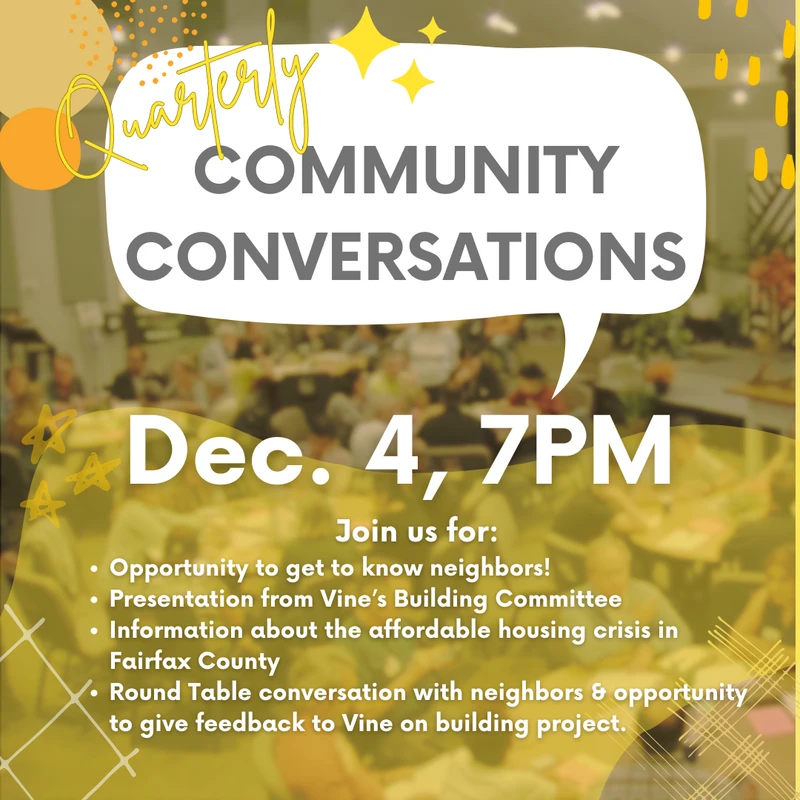
We don’t have a precise timeline yet, but we commit to quarterly town halls and website updates to keep you informed.
• Concern: Will Affordable Housing Make the Neighborhood Less Safe?
What We Know:
Decades of academic research show that affordable housing does not increase crime. In fact, in many cases, it reduces crime.
“Affordable housing either decreases or does not affect crime rates. Violent and property crime tends to go down in lower-income neighborhoods after new housing is built. Rates of domestic violence also fall. Overall, there is no evidence that affordable housing increases crime.”
– Bell Policy Center
📚 Sources:
• Concern: Affordable housing is desperately needed for many reasons, including environmental impact. Exclusive single family zoning creates car-dependent neighborhoods and increases traffic and emissions.
As a church community we share this concern and became more aware of it as part of our learning and engaging community partners and county leadership over the last few years – in addition to research.
“Residential segregation results in a disproportionate distribution of environmental health burdens along racial lines. Across all kinds and colors of neighborhoods, single-family zoning maximizes land consumption for housing, creating car-dependent neighborhoods with greater travel distances, more car trips, more traffic, and more emissions. Consequently, these neighborhoods’ social realm shifts from public spaces like sidewalks to private spaces like yards, with a corresponding decrease in social capital. “ – Brookings
• Concern: Will This Cause More Traffic?
What We Know:
🚗 This is a valid and shared concern. A traffic study will be conducted as part of the process, and traffic impact will be taken into account.
• Concern: Will This Change the Feel of the Neighborhood?
What We’ve Heard:
Some neighbors hope this section of Gallows Road remains single-family homes only.
Our Perspective:
🏙️ While we understand the desire to preserve neighborhood character, restricting all development limits community access to:
- Public transit (Metro, Bus Rapid Transit)
- Local economic hubs (Tysons, Mosaic, INOVA)
- Public amenities and investments
🌳 We believe in adding value to the neighborhood with:
- Accessible playgrounds
- Walking and biking trails
- Benches and shared open spaces
- Well designed space that fits the feel and improves the look of the neighborhood
• Concern: Will Cedar Street Be Connected to Sandberg?
What We Know:
🚫 It is Vine’s priority to prevent this connection.
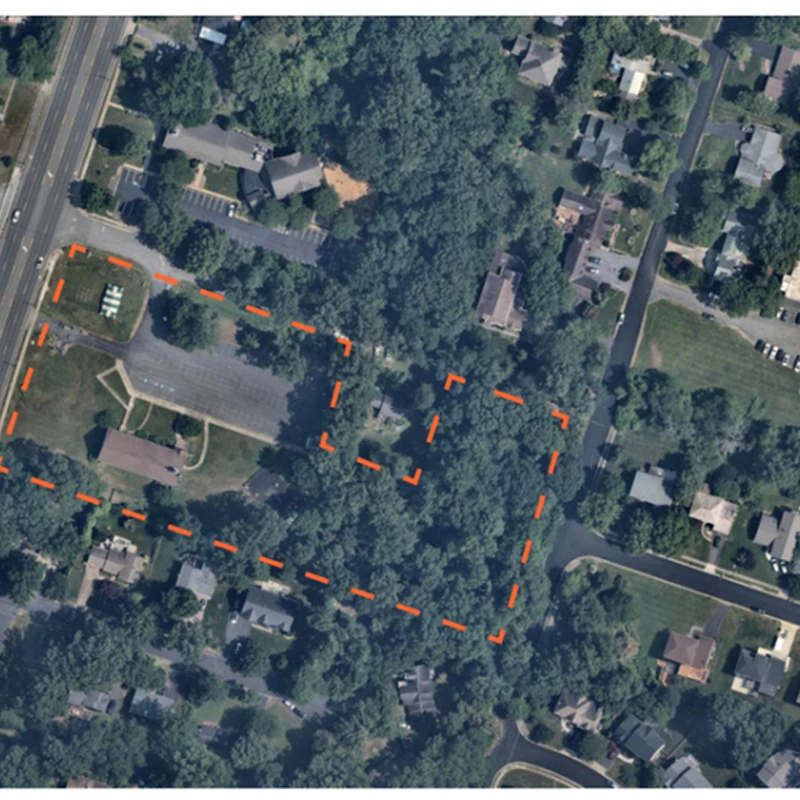
Vine has heard our neighbors and is committed to preventing this connection to avoid through-traffic from entering the neighborhood behind Vine Church. Our proposal does not include any drivable connection.
• Concern: Is Affordable Housing Helpful or Harmful to Low-Income Families?
What Research Shows:
🏡 When done right, affordable housing is a stepping stone to stability — not a trap.
Without it, families often face:
- High housing costs
- Instability or homelessness
- Barriers to escaping poverty
Benefits of Affordable Housing:
- Improved financial security
- Better physical & mental health
- Higher educational outcomes
- Increased access to jobs and services
📚 Learn more:
• Concern: Vine isn’t listening to the community.
Our Perspective:
We Hear You — Even When We Don’t Fully Agree
We’ve heard from some neighbors who feel strongly that there should be no change to our property, or who feel unheard when their desire for “no change” or “not here” is not reflected in the path forward.
We want to acknowledge that change is difficult, and it’s completely valid to feel concerned, frustrated, or even skeptical. Feeling heard is not the same as being agreed with — and we know that can be hard.
Our commitment is to listen well, to hear both the specific concerns of those who prefer little or no change, and also the needs of the broader community who may benefit from greater access to housing, services, and opportunity.
Even when we don’t all come to the same conclusion, we can move forward with mutual respect, transparency, and a shared goal of strengthening our community.
• Concern: Vine is listening to people who aren’t neighbors.
What We’ve Heard:
Some believe that only those living directly around the church—or on nearby streets—should be considered “neighbors” whose voices matter in this conversation.
Our Perspective:
We deeply value the input of those who live closest to this property. Your perspective is essential, and your concerns are taken seriously.
👥 At the same time, our understanding of neighbor is rooted in a broader, Biblically inspired calling: to see all people as our neighbors. We also recognize the many people who are part of our daily lives, yet may not have the same access to housing in our community.
These include:
- The teachers and county staff who educate & serve our children
- The EMTs, nurses, and hospital staff who care for our families
- The workers who maintain our homes, drive our buses, and keep our community running
These neighbors are already present in our lives—working on our streets, in our schools, and in our homes. But too often, they cannot afford to live here.
We believe that building thoughtfully planned affordable housing is a way to extend opportunity, dignity, and belonging—not just to those who are already here, but to those who already serve here every day.
🏘️ Our goal is simple: to expand the circle of community without shrinking the quality of life for anyone.
• Concern: Vine is engaging this project for the single purpose of making a profit.
What We’ve Heard:
Vine is selling part of its property as a means to raise money to build something bigger and better for themselves.
💡 Let us be clear: this project is not about profit; it is about loving the community and bettering the neighborhood.
Vine Church is financially healthy and stable. Instead of developing our property by other means we’ve chosen a more collaborative and service-oriented path. No “profit” is anticipated.
Our vision includes:
- A new church and community center
- An accessible, inclusive playground
- Open, welcoming grounds for walking, biking, and gathering
We’re partnering with an affordable housing developer through a land lease—not a sale. The anticipated developer (an independent entity) will build and manage the housing.
🏗️ Our goal: To be a blessing to the neighborhood and meet real, present needs.
• Concern: Will this lower nearby property values?
No.
Studies—including one in nearby Alexandria, VA—show that well-managed affordable housing has no negative impact on surrounding property values. In some cases, it slightly increases them.
“Empirical research provides little evidence that subsidized housing depresses neighborhood property values.”
– Urban Institute
• Concern: Single-family zoning keeps traffic low and our air clean. Why change it?
In fact, exclusive single-family zoning creates more traffic and emissions by forcing car-dependence.
“It maximizes land use, increases travel distances and emissions, and reduces public gathering spaces and social capital.”
– Brookings Institution
• Concern: Is affordable housing right for this neighborhood?
Yes. Affordable housing today is:
- Architecturally indistinguishable from market-rate housing.
- Designed with care, sustainability, and community in mind.
- A way to ensure our neighborhood remains inclusive, not exclusive.
“Transformation of zoning can lead to transformation of places—into vibrant, equitable, and sustainable communities.”
– Brookings
• Concern: We bought our home here because we liked the neighborhood as it is. We don’t want it to change.
We hear you. Change is hard.
- This project came only after years of prayer, discernment, and conversation. We believe loving our neighbors includes creating space for them.
- One neighbor told Pastor Katie:
“At first, we didn’t want this. But then we realized—this neighborhood was once someone else’s uncomfortable change too.”
📌 Bottom line: Everyone benefits when all communities do their part. Let’s be part of the solution.